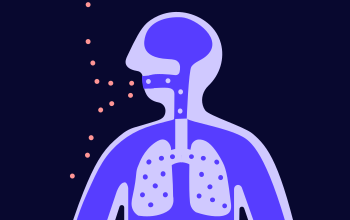
What happens when we breathe?
Learn what happens to your body with each breath.
How do we breathe?
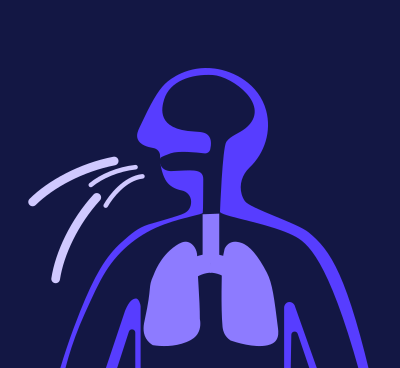
Although we all breathe about 20,000 times per day, it's easy to forget how mind-blowing and complex it is. Breathing is a sophisticated chemical and physical symphony that moves with the rhythm of life, whether we are sleeping, relaxing, or running a marathon. Breathing captures oxygen from the air we breathe, which we use to crack open sugar and use its energy to fuel everything in our bodies, from our heart beating, to thinking and digesting food. If we were to stop breathing, we would only survive for about 6 minutes. It's definitely worth learning more!
Healthy lungs are a bit like 2 spongy, squishy balloons that fill our chest on either side of our heart. Air gets into our lungs through a complex network of tubes, and finally, tiny air sacs, called alveoli. Alveoli are where oxygen enters our blood, and carbon dioxide is removed. Our lungs get bigger and smaller when our main breathing muscle, a thick band in our belly called our diaphragm tightens, and relaxes. Our lungs are encased in a double-layered, slippery sac called the pleura, that allows our lungs to glide smoothly as we breathe in and out.
By understanding how breathing works, we can build a better awareness of our bodies, our minds, and the intimate connection between them. This can help us become more attuned to how our thoughts and feelings impact our breathing, and help us take control by changing how quickly and deeply we breathe by practicing breathing exercises.
Let's take a breath in...
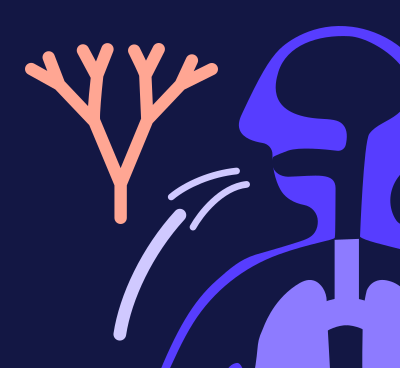
When we breathe in, our breathing muscles tighten which expands our chest. This causes the pressure in our lungs to drop compared to the pressure of air outside our bodies. To balance things out, air is sucked into our lungs through our nose. The air we breathe in, which is about 1/5 oxygen, is filtered, warmed and moistened by our noses as it enters our bodies.
Next, our breath of air travels through our lungs via a complex, branching network of smaller and smaller tubes. These tubes are lined with a protective barrier made of sticky mucus which traps invaders such as bacteria. Tiny embedded hairs called cilia beat rhythmically and propel mucus up and away from our lungs - this helps keep our lungs healthy and free of infection.
Once air arrives at the tiniest tube, it inflates clusters of miniscule, ultra-thin air sacs that look like a bunch of grapes. We have hundreds of millions of these air sacs, called alveoli, which are incredibly specialised and important. This is where the real magic happens!
Alveoli sacs are the gateway between our lungs and our bloodstream, as they are hugged by a network of tiny blood-filled tubes, called capillaries. Alveoli can be thought of as a busy currency exchange point - we trade in oxygen and take out carbon dioxide, and it's happening in our bodies every moment of every day.
Once in our bloodstream, oxygen molecules are safely transported by a special protein called haemoglobin. Our red blood cells carry an enormous cargo of oxygen-packed haemoglobin - about 280 million haemoglobin units each. As our red blood cells travel through our bodies via our bloodstream, haemoglobin changes its shape, releasing oxygen where it is needed most.
At any given time, a certain percentage of our haemoglobin is carrying oxygen - this is called our blood oxygen saturation or 'O2 sats'. If we're breathing normally our O2 sats are usually around 98-100%, though this can drop if we're unwell, or in a place where there is less oxygen in the air, like the top of a mountain.

And let's take a deep breath out...
As we go about our day, we are constantly using up oxygen as fuel, and producing carbon dioxide, a waste product we need to get rid of. Carbon dioxide takes the opposite route in our bloodstream back to our lungs and is expelled through the airways.
When carbon dioxide arrives at our lungs' exchange point, it seeps into our alveoli air sacs, ready for us to breathe out.
Breathing out is passive - our thick muscular diaphragm relaxes, pushing up on the lungs and making them smaller. This causes the pressure in our lungs to increase compared to the pressure of air outside our bodies, which pushes carbon dioxide gas out of our lungs, and we breathe out through our mouths.
Healthy lungs and diaphragms are elastic, like a rubber band, and they snap back with each cycle of breathing in and out – which is good news as they have thousands more breaths to take today!
How our bodies control our breathing
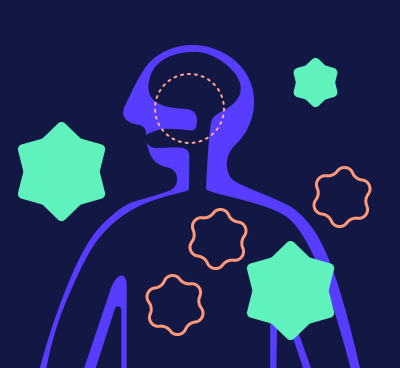
A series of sensors in our bodies diligently monitor the levels of gas in our blood. If something isn't right, our sensors tell our brain to change the way we are breathing to restore balance.
Our brains are very particular about the amount of carbon dioxide in our blood and contain their own sensors to keep it under strict control. When there is too much carbon dioxide in our blood, our sensors alert our brain, which tells our bodies to take faster and deeper breaths to get rid of the extra carbon dioxide. In contrast, when there isn't enough carbon dioxide in our blood our brain instructs our bodies to take fewer, shallow breaths.
Our lives depend on us bringing in oxygen and getting rid of carbon dioxide effectively. That's why our bodies have backup sensors in our arteries that monitor the amount of oxygen in our blood. When something isn't right these sensors sound the alarm and our brains modify our breathing to restore balance.
What is hyperventilation?
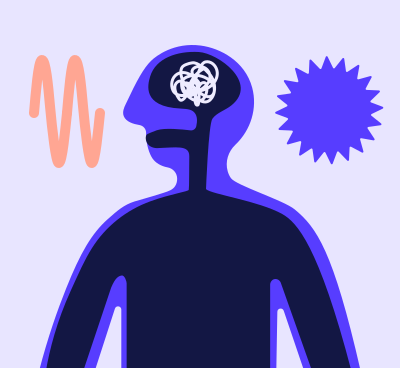
Hyperventilation is when our bodies take very rapid or deep breaths and is sometimes called over-breathing. Hyperventilation can feel very unpleasant and is an instantaneous physical response that is often triggered when we feel anxious, panicked, or stressed.
Hyperventilation disrupts the delicate balance of oxygen and carbon dioxide in our blood. Our bodies are constantly using oxygen as fuel and producing carbon dioxide as a waste. Usually, the rhythm of our breathing brings in the amount of oxygen our bodies need and removes the carbon dioxide we produce. However, when we breathe too quickly or deeply, our bodies remove too much carbon dioxide.
Low carbon dioxide tightens the tubes that supply our brains with blood, which can cause us to faint or feel dizzy. It is also common to experience muscle cramps or tingling in our hands and feet if we are breathing too deeply or rapidly.
Although hyperventilation is often our bodies' immediate response to us feeling stressed, anxious, or panicked, breathing exercises can help us restore calm. We can exert a powerful influence on our bodies by deliberately thinking about the rate and depth of our breaths.
Our main breathing muscle and our brains are connected to each other directly by our vagus nerve. When we breathe out deeply during breathing exercises, our vagus nerve tells our brain to activate our bodies' relaxation mode, which can help us feel calmer.
What is hypoventilation?
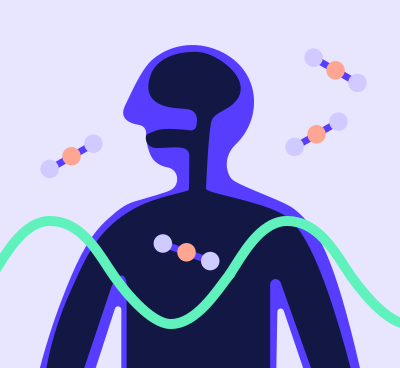
Hypoventilation is the opposite of hyperventilation, it is when we breathe too little. There are many causes of hypoventilation, which lead us to take shallower, less effective breaths, including neurological problems such as strokes, certain drugs and obesity.
Our bodies work very hard to maintain balance – ordinarily, our breathing closely matches the amount of oxygen our bodies need for fuel and the amount of carbon dioxide gas we produce and need to get rid of. When we breathe out less often or less deeply than usual, we are unable to remove carbon dioxide at the rate our bodies produce it. This can cause carbon dioxide to build up in our blood, which makes our blood acidic.
A buildup of carbon dioxide in our blood can cause headaches and make us feel confused and drowsy. Additionally, long-term or night-time hypoventilation can disrupt our sleep and leave us feeling fatigued.
Breathing exercises guide us through fully filling and emptying our lungs, which reduces the amount of stale, trapped air in our lungs, and allows us to get the most out of each breath. With each deep breath in and out, we supply more oxygen to our bodies, and get rid of carbon dioxide more effectively. Breathing exercises can also build strength in our breathing muscles, which can help us breathe easier throughout the day.
Lungy can encourage you to take deep breaths, filling and emptying your lungs fully, whilst also giving time for your to slow down and reflect on your breathing. Lungy's Recharge mode is designed to encourage you to breathe in and out to a certain volume - try to fill up the indicator bar if you can with each breath out. After each exercise you'll also get an approximate volume for the amount of air you breathed out during the exercise - it can be anything from a grapefruit to a watermelon!
We hope you enjoyed this learning module and learnt something useful about your complex and beautiful respiratory system!
Ready to practice?
Download Lungy to put these techniques into practice with real-time breathing exercises guided by your own breath.